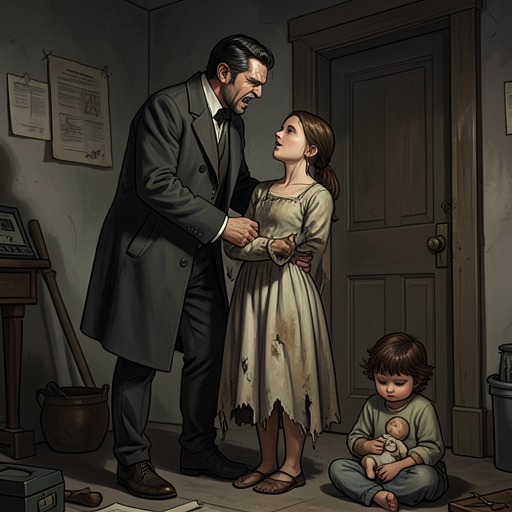
Stephen Huntley
Mothering SundayStephen Huntley is Lavinia Huntley’s premature son and the child whose brief survival gives her the experience of motherhood she has long desired. Born dangerously small after three daughters had died, he is welcomed with devotion by his mother and sustained by the care of Zillah and Molly Worthington. His life ends in infancy when measles reaches his chest. The contrast between Lavinia’s intimate attachment to him and Ashley Huntley’s concern with having a male heir makes Stephen’s short life a measure of both maternal love and dynastic expectation.
Birth and Identity
Stephen is born much too early, following a difficult delivery in which Lavinia is also in danger. At first he appears almost lifeless. Zillah follows the doctor’s instructions, warms and stimulates the child, and finally hears him make a small cry. His survival is uncertain: he is tiny, his lips are blue, his breathing shallow, and his skin nearly translucent. Clothes prepared for him overwhelm his slight body. The doctor warns that he may not live and doubts Lavinia will be strong enough to feed him herself.
Ashley arrives while the doctor is still treating Lavinia. On learning that the baby is a boy, he celebrates the birth of a son and immediately thinks of informing Mr Wilde. He does not look at the child before leaving. Zillah, appalled by this response, concentrates on keeping the infant warm and alive. Her practical intervention establishes the care Stephen receives in his first hours, in contrast to his father’s focus on the news of a male heir.
The child is named Stephen, with Walter as his middle name in honor of Ashley’s late uncle. Reverend Edgar Lockett comes to the nursery and formally welcomes him into the Church, blessing his forehead with holy water while praying for the fragile baby to live. The ceremony gives the precarious infant a name and a place in the community even as those present fear that his life may be very short.
Care and Lavinia’s Attachment
Because Lavinia cannot nurse him, Zillah proposes finding a wet nurse nearby: a woman in Hartshill who has recently given birth to a healthy girl. Zillah suggests that the woman be paid to move into the nursery with her own child, so Stephen can be fed and watched there. Molly Worthington becomes his nurse. Her care is steady, and the narrative later presents her doing all she can to tend him through illness.
When Lavinia is strong enough to focus on her son, she kisses his tiny bald head and experiences a rush of protective love unlike anything she has known. His opening eyes make the connection immediate and personal: he is not merely the long-awaited son but a living child she can love and bring up. She imagines him, when grown, bringing her flowers at the Mothering Sunday service. That future image matters because she has watched other mothers receive their children’s bouquets while she had no child of her own to share the occasion with. Stephen’s presence seems to end that painful exclusion and open a future she has wanted throughout her life.
Her joy also stands against her awareness of Ashley’s priorities. Lavinia bitterly supposes he has already informed the lawyers about the birth, while Zillah avoids encouraging a conversation that might distress her as she recovers. The baby’s arrival thus holds different meanings for his parents: to Lavinia he is a beloved child and the promise of a maternal life; to Ashley, the announcement of a son carries the weight of succession. Stephen’s short life never allows the future his mother imagines to unfold.
Illness and Death
Stephen later develops measles. When Lavinia enters the nursery, she finds him stripped to his binder and lying on his blankets while Molly tries to reduce his fever by sponging him with cool water. Marigold is ill as well, but appears less seriously affected. Lavinia lifts Stephen and rocks him, alarmed by the heat of his body; Molly explains that a slight cold had worsened during the night and that the rash had appeared. Lavinia reassures Molly that she has been an excellent nurse rather than blaming her for the child’s decline.
The doctor finds that the infection has reached Stephen’s chest. He prescribes a sleeping draught, continued cooling, and attempts to give the child liquid, but can offer no assurance of recovery. He asks whether Stephen’s father is present and advises that Ashley be summoned. Lavinia can only say that he is still in London. The absence is consequential: when she later tells Ashley that Stephen has died, she says that he could not even be contacted—his own father.
During the night, Lavinia remains beside Stephen, holding him against her breast. Zillah, exhausted, falls into an uneasy doze and wakes at dawn to a silence in the nursery. She finds the fire nearly out and then realizes Stephen is no longer crying. Lavinia is still in the nursing chair with the baby in her arms. When Zillah touches his cold forehead, she understands that he has died quietly in the night. Lavinia refuses to hand him over and asks to be left alone with him. The intimacy of that vigil gives the death its emotional force: the child she had pictured growing up has become still in her arms before she can release him.
Burial and Narrative Significance
Cissie carries news of Stephen’s death to Sunday and explains that Lavinia held his body for much of the night; the undertaker could not take him until the family had nearly to prise him from her arms. Stephen is buried in a churchyard because he had lived. Lavinia’s daughters, who had not drawn breath, were buried in the grounds of Treetops Manor. The distinction makes Stephen’s brief life consequential even in death, while the burial also marks the loss of the future Lavinia had attached to him.
Two weeks after his death, Lavinia tells Ashley that Stephen had measles and that the funeral took place the previous week. Ashley first asks whether the child recovered, then reacts with disbelief and accuses her of making a malicious game of the news. Lavinia insists that it is true and confronts him with his absence. His response reinforces the gap between the son he celebrated as an heir and the infant whose illness and death he failed to witness.
Stephen’s characterization is necessarily brief, but his significance extends beyond his few months of life. His birth follows the loss of Lavinia’s daughters and offers her a rare, intensely felt assurance that she can love and raise a living child. His death turns that hope into grief, while the care given by Zillah and Molly shows the network of women sustaining him where his father’s attention is directed elsewhere. The imagined Mothering Sunday flowers, first a sign of the future Lavinia longs for, become a measure of what his death has taken from her.